

John Moses Browning’s brainchild 1911 design literally changed the world of pistol shooting. From its inception to its adoption by the military – a very interesting story in itself – throughout its storied career, ol’ slab sides, as it has affectionately been referred to, is arguably the most recognizable pistol in the world by non-shooters.
There’s a reason for that: originally chambered in .45 ACP, the gun had (has) a reputation for one-shot stops. Its 230-grain FMJ bullet was greatly feared by those on the other side of the front sight. I had a cousin (second cousin, actually), Billy, who was in the Air Force and was stationed in Japan after the war. He was tasked with helping to keep the peace. He said they’d roll up to a scene where looting or other nastiness was occurring and pull out their M1 carbines. Typically, that had no effect on stopping the activity, but when they pulled out their .45s, all nefarious actions would cease. It seems the bad guys wanted no part of the .45 ACP.
I could go on and on about the .45 in the 1911, but this article is about other calibers available in that platform. Let’s take a quick look at some of these non-.45 calibers. We’ll list a few of the mainline calibers (there are some esoteric ones out there that are beyond the scope of this article) and look at some of the reasons they are popular.
Most of these calibers work very well in the Browning short-recoil-action 1911. Being a locked-breech action helps contain pressures that might make lesser pistols tremble. So, literally anything from the lowly .22LR up to the deer-busting 10mm can be effectively fired in the 1911. Let’s look at the most popular non-.45 calibers that 1911s are sold in today.
.22 LR
First, there’s the .22 LR. 1911s have been chambered in that caliber for decades, and have mostly been used as training guns for the “real deal”. I’ve owned a couple of them myself, and my son still has one. They are very useful. New shooters can learn the 1911 Manual of Arms and get lots of low-recoil-low-noise shooting in before graduating to a centerfire model. Many rimfire 1911s are accurate enough for small-game hunting.
- Abundant ammo
- Low shooting cost
- Low recoil and noise
- Great training aid “starter gun” before moving to a centerfire caliber
- Good woods-walking gun
Live Inventory Price Checker
|
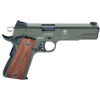
GSG 1911 22LR Pistol 5" Threaded Barrel 10+1 Round Olive Drab | MidwayUSA | $ 324.99 |
|
|
|
Mauser Model 1911 .22LR Pistol 5" 10rds, Tan - 4110604 | Palmetto State Armory | $ 350.99 $ 318.99 |
|

|
Browning 1911-22 22LR Pistol 4.87" Threaded Barrel 10+1 Round Black Slide Gray Grip Black Frame | MidwayUSA | $ 799.99 |
|
|
|
Browning 1911-22 Black Label Suppressor Ready Full Size .22lr Pistol w/ Rail, Matte - 051820490 | Palmetto State Armory | $ 857.99 $ 779.99 |
|
.38 Super
Next, there’s the .38 Super. This caliber was one of the original non-.45 calibers to be chambered in 1911s. It was very popular in some South American countries, as laws there precluded owning pistols in military calibers. That effectively ruled out .45 ACP and 9mm. I believe that the .38 Super, which behaves like a 9mm on steroids, was popular for that reason. It is a powerful round. Typically it is loaded about 200 fps faster than the 9mm. It came out in 1929 as a possible solution to penetration issues suffered by the .38 Special and .45 ACP. Today, many competitive shooters use it in matches as it makes major power factor without .45ACP-style recoil in USPSA or similar contests. One of its only downsides is that it is not as available and it costs more than 9mm.
- More powerful than 9mm – sort of a “9mm Magnum”
- Makes major power factor with reduced recoil
- Popular hunting round for small to medium game
- Magazines can hold more rounds than .45 ACP
9mm
Let’s not overlook the 9mm. That caliber had been popular in Europe (it was released in 1902) for years before Colt introduced its aluminum-framed Commander model in 1949. It was chambered in either .45ACP or 9mm. Originally intended as an officer’s gun, once it was available in quantity, sales took off among civilian shooters. Of course, they had no idea that in the mid-1980s we would transition to a 9mm sidearm and slowly phase out the .45 (which has never totally happened – they are still in use by many special units). Why is the 1911 9mm so popular when compared with the .45ACP? It seems that whenever I read about a new 1911 being introduced, it’s in 9mm nowadays and seldom in .45. In this world of 9mm “plastic fantastics” – polymer-framed striker-fired pistols – the old-fashioned single-action 1911 is still a very popular option in that opinion.
- Magazine capacity is greater
- Recoil and noise are less
- Cost of ammo is less than .45ACP
- Ammo availability is very good
- Availability of pistols is excellent in 9mm

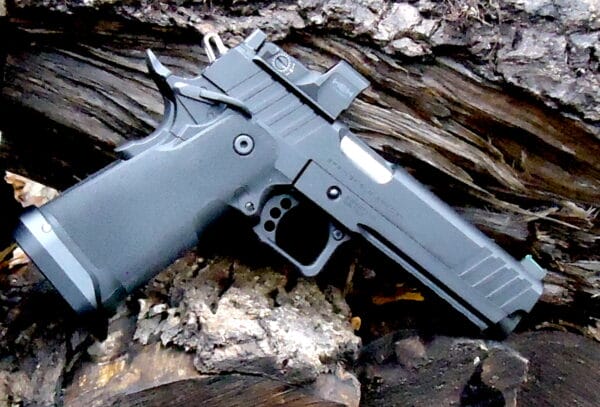
This is one fine 1911…in 9mm.
Live Inventory Price Checker
|
|
Springfield Prodigy 1911 9mm Pistol 4.25" 20rd/17rd 4.25" - PH9117AOS | Palmetto State Armory | $ 1532.99 $ 1380.99 |
|
|
|
Springfield Emissary 1911 9mm Pistol SS 9rd 4.2" - PX9217L | Palmetto State Armory | $ 1056.99 $ 951.99 |
|
|
|
American Classic Government 1911 9mm Pistol, 5" Barrel, Fixed Sights, Black - 85604 | Palmetto State Armory | $ 591.99 $ 537.99 |
|
|
|
Watchtower Apache Double Stack 1911 9mm 4.60" 17/20rds Pistol, Graphite - Double Stack 1911 with Graphite Finish - APACHE9MM46CPR | Palmetto State Armory | $ 4661.99 $ 4199.99 |
|
10mm
I’ve always wanted a 1911 in 10mm. Although a bit much for everyday carry, it shines as a hunting piece. Here in the Hoosier state, it is deer-legal. The full-bore Big 10 is a bit much in some pistols, but not the locked breech 1911. I once borrowed a friend’s Colt Delta Elite in 10mm … it was a handful but pleasant to shoot. The 10mm is a natural caliber to be chambered in 1911s as it is so versatile. If you have to punch through metal, glass, or a deer, the 10mm is what you want.
- Ammo is available and reasonably priced
- Many companies make 10mm 1911s
- Downloaded ammo is available and makes for good practice sessions
- The 10mm is one of few 1911 chamberings good for medium game
40 S&W
Lastly, there’s the 40 S&W. Some shooters think of it as a down-loaded 10mm, and they are correct – that’s how it came about. When some F.B.I. agents had trouble controlling their new 10mm pistols, a request was made to download the energetic cartridge. Long story short, the .40 S&W was born. Derisively referred by some shooters as the “.40 Short-and Weak”, it nonetheless has earned a reputation as a decent stopper. Many law enforcement agencies adopted it. But, in recent years, many of those agencies have gone back to the 9mm with its lower recoil and greater magazine capacity. For those .40 fans out there, 1911 pistols are still being made. Here’s my two cents’ worth: the .40 shines in a 1911. The larger, single-action pistol is a great platform for this round. Smaller pistols can be harder to control, but the 1911 evens things out.
- Powerful, great for concealed carry
- Ammo is available
- Different ammo power levels are available
- Ammo cost is reasonable
There you have it. These are the major, non-.45ACP calibers that 1911s can be purchased in today. Like I said, there are a few other calibers that I do not consider mainstream, like the 7.65 Parabellum or the .400 Corbon, but for those who like unique calibers, they’re out there.
Why Would You Want A Non-.45 1911?
We have four wonderful sons, all of whom are shooters. But one of them is really into it – he just bought a Springfield Armory Prodigy 9mm 1911. Why? He’s looking at getting into competition and wanted a great-quality, versatile pistol. He chose 9mm because of the reasons I stated above – great magazine capacity, less felt recoil and noise, easy access to dozens of different 9mm loads, etc. His experience sort of underlines this article’s theme – the popularity of non-.45 1911s.
Different shooters have different reasons for wanting guns. I mentioned competition – that’s one use. Others may be looking to go afield and take down medium-size game, so they invest in a 10mm. There are as many reasons to own one of the non-.45 1911s as there are shooters.
One reason that folks buy a pistol whose design is well over a century old when newer, “modern-action” pistols abound is the 1911 trigger. Being a single-action pistol, the 1911 trigger is among the finest of any pistol type. That Prodigy I mentioned above has a trigger you want to write home about, if you didn’t already live there. It broke right at 3 pounds with zero take-up and creep. Nice! Technically, it is a 2011 since it has magazine capacity up to 26 rounds and a Pic rail on the dustcover, but Springfield advertises it as a 1911.
That’s the cool thing about the old warhorse… it is easily updated. Don’t like that trigger? Replace it. Want a different grip safety or to maybe install an ambidextrous safety? Just do it. Parts availability is great… folks have been making third-party items for 1911s for about as long as it’s been around.
Maybe you don’t need the .45’s huge punkin ball, but are happy with something from a smaller squash family like the 9mm provides. Or, maybe you just acquired/inherited a huge pile of .38 Super or .40 S&W or 10mm ammo and have always wanted a quality 1911 – now’s your chance! There are a ton of reasons to want one of these.
Summing Up
When I first started out shooting earnestly around 1978, the .45 ACP was king of semi-auto pistol calibers. NRA Bullseye competition was still popular and usually revolved around the .38 Special or the .45ACP. The three caliber designations that the NRA recognized were .22 rimfire, .32 or greater centerfire, and .45ACP. That tells you something.
But today is different. With the adoption of the 9mm by NATO and our military (not to mention law enforcement), that guarantees a pretty steady supply of ammo and guns. I see the .45ACP as all but being eclipsed by the 9mm, even though I’m still a huge fan.
Therefore, it only makes sense to look to alternative calibers in the 1911 platform. Whether you go with a 9 or 10mm, a .38 Super, a .22, or a .40 S&W, you’re in good company. I look on it as combining something old and something new, sort of like my clothes. Using the 9mm as an example, you get the availability of cheaper ammo and lower recoil plus a greater magazine capacity, all tied up in a nice single-action 1911 package with a great trigger and sights. What’s not to like?
About Mike Hardesty
With experience spanning over 45 years, Mike Hardesty has long enjoyed shooting and reloading. An inveterate reloader, he casts bullets and reloads for a diverse array of firearms, each handled with long-practiced precision. Living in rural Indiana, his homestead boasts a personal 100-yard range where he shares his love for guns to his four sons, their wives, and eleven grandchildren. As a recognized author, his writings have been featured in notable platforms like Sniper Country, Bear Creek Arsenal Blog, Pew Pew Tactical, TTAG, Dillon Precision’s Blue Press, and Gun Made, revealing his ongoing passion for firearms at the age of 72.

Add to these 45 Super, 460 Rowland, 357 Sig and 357 Magnum. All these increase power. Two of these use the same mags as 45 ACP. One has 357 magnum ballistics and one is 357 magnum (Conan Arms). Most of the calibers that are mentioned can be had is double stack variety which increases capacity by nearly 2x. There is nothing on the North American continent that 460 Rowland and 45 Super can’t take and you can safely hunt deer and maybe elk with the others. There are good reasons that 1911’s are still with us even after 113 years… Read more »
They are all good.
Don’t forget a couple more of the esoteric 45ACP calibers for the 1911.
Such as the 45 Super & the 460 Rowland.
Doable without major modifications to the 45ACP frame.
The best reason for buying a 1911 in a different chambering?
“I don’t own one yet!”
Stallone used a 9mm 1911 in the movie ‘Cobra’ (1986), because back then they still hadn’t for whatever reason perfecting the 1911 to use 45ACP blanks.
Even in the movie ‘The Wild Bunch’ (1969), everyone who carried a 1911 45ACP did so, until the scene called for them to shoot it. They they switched to a Star 9mm, which from a distance looks identical to a 1911 45ACP.
I don’t need a mag loader for single stack guns but old hands force using one otherwise. I shoot 9mm in the EZ but still enjoy 45 in my 1911’s and down a couple Tylenol afterwards. It’s worth it.
I have one in 9mm. It’s accurate, soft-recoiling, fun to shoot, and ammo costs a lot less than 45 ACP..
I have owned half a dozen 1911s over the years. All Colt’s with one exception. I always shot them well.Shot Expert in the Army in the early 80s. I don’t currently own one. I do own an M&P 45 converted to shoot 45 Super. This conversion entailed replacing the recoil spring to a 22lb unit. Now it’s my trail gun. We have moose and occasional griz around here. I would love to do this with a 1911 but, the good ones are a bit spendy for me these days. Same goes for a 357Sig pistol. I imagine a 357Sig 1911… Read more »
I’ve owned a few in .22 LR and every one was a jam-o-matic, regardless of ammo or gunsmithing.All the others are solid recommendations.
In black powder days, many, if not most pistols were .50 or larger. As time went on and rifling, better powder and ignition systems came along defensive pistol bores were shrunk down. Then came the Philippine rebellion. We had shrunk our army’s defensive handgun bores down to .38 caliber. They didn’t work on drug fueled Moro warriors, who could absorb quite a few .38s before succumbing. A few old cavalry 1873 Colts were on hand, and they worked. We had weenied our handgun down until it didn’t work any longer, and we upsized it until it did, in the .45… Read more »