
In Jaymes v. Bonta, filed on October 13, 2025, in the U.S. District Court for the Southern District of California, a coalition of plaintiffs led by the National Rifle Association (NRA), Firearms Policy Coalition (FPC), and Second Amendment Foundation (SAF) is suing California Attorney General Rob Bonta over a newly enacted firearm restriction. The case represents the latest flashpoint in the ongoing legal battle over the reach of the Second Amendment following the Supreme Court’s landmark decisions in District of Columbia v. Heller and New York State Rifle & Pistol Association v. Bruen.
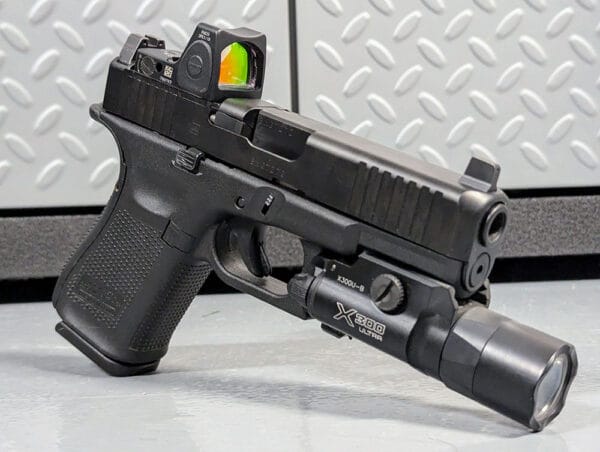
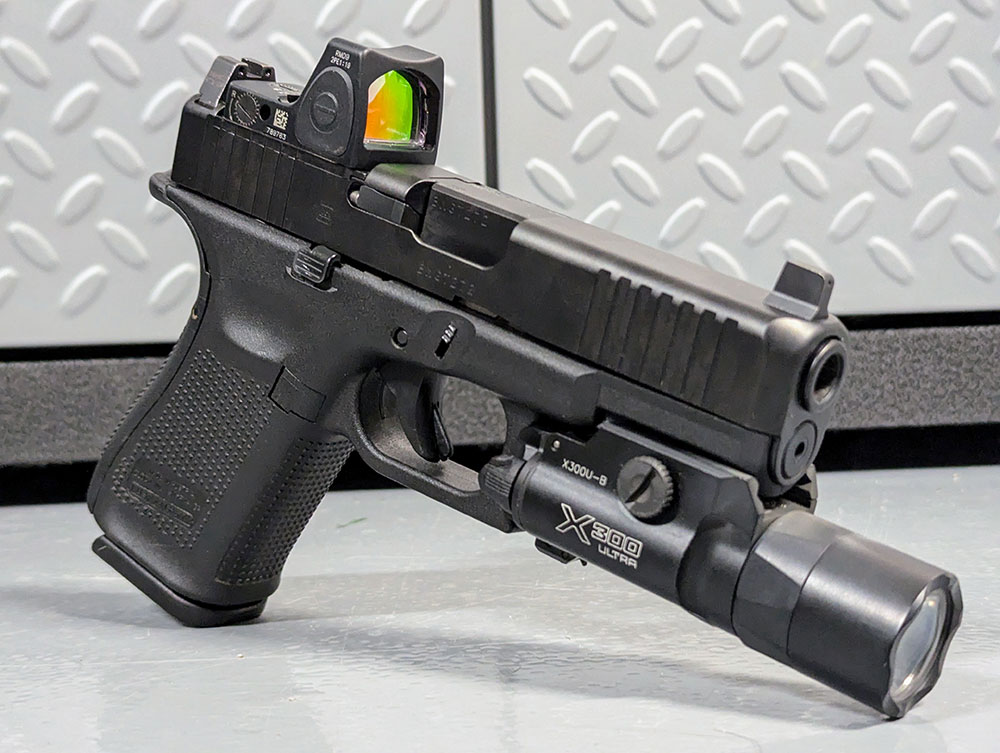
At the heart of the lawsuit is California Assembly Bill 1127. The law, signed by Governor Gavin Newsom on October 10, 2025, will take effect on July 1, 2026, and prohibits licensed firearms dealers from selling, transferring, or delivering what California calls “semiautomatic machinegun-convertible pistol.” The statute targets handguns with a “cruciform trigger bar,” a design feature found primarily in Glock and Glock-style pistols. Glocks are the most popular handguns in the United States.
The plaintiffs argue that the new law violates the Second and Fourteenth Amendments by effectively banning the commercial sale of one of the most common handguns in America. They assert that the ban prevents ordinary, law-abiding Californians from acquiring firearms that are “in common use,” which the Supreme Court has repeatedly held are protected under the Constitution.
The plaintiffs include individual gun owners, firearms dealers, and major gun rights organizations. Danielle Jaymes, a San Diego County resident, alleges she would purchase one of the banned handguns after July 2026 if the law were not in place. PWGG, L.P., doing business as Poway Weapons & Gear, and its president, John Phillips, claim the law will prevent them from selling popular handguns they have legally sold for over a decade. The NRA, FPC, and SAF joined as organizational plaintiffs representing their members statewide.
Their attorneys, led by Bradley Benbrook of Benbrook Law Group and David Thompson of the Washington, D.C.-based Cooper & Kirk firm, seek declaratory and injunctive relief, asking the Court to strike down the law before it takes effect. The plaintiffs frame the case as a clear constitutional question: whether the state can prohibit the sale of handguns that millions of Americans own and use lawfully.
Live Inventory Price Checker
|
Glock Factory Dual Recoil Spring Assembly 9mm Luger Glock 19 Gen 5, 19X, 45, 45 MOS | MidwayUSA | $ 20.99 |
|
|
Glock MOS Cover Plate 01 9mm Luger DLC Glock 17 Gen 5 MOS, 19 Gen 5 MOS, 26 Gen 5 MOS, 34 Gen 5 MOS, 45 MOS | MidwayUSA | $ 8.99 |
|
|
|
LaserMax Red Guide Rod Laser for Glock 19, 19 MOS Gen 5, Glock 19X, 45 Pistols - LMS-G519 | Palmetto State Armory | $ 298.99 $ 268.99 |
|
|
|
Safariland Black ALS Holster for Glock 19 MOS Gen 3-4 | Ammunition Depot | $ 90.49 |
|
Under AB 1127, dealers may not “sell, offer for sale, exchange, give, transfer, or deliver any semiautomatic machinegun-convertible pistol.” The law defines such a pistol as any semiautomatic handgun with a cruciform trigger bar that can be “readily converted” into a machine gun through the installation of a “pistol converter.” These small attachments replace the slide’s backplate and are known as “Glock switches.”
California already bans pistol converters and treats them as illegal machine guns under state and federal law. But the new statute goes further by prohibiting the underlying pistols themselves, even when sold without any converter device. In effect, the plaintiffs argue, the law punishes manufacturers and dealers for selling perfectly legal semiautomatic firearms merely because those guns share a design characteristic that could allow modification.
According to the complaint, this approach mirrors and expands upon California’s longstanding restrictions on so-called “unsafe handguns,” a regulatory scheme that has been under continuous constitutional challenge. The plaintiffs note that in Renna v. Bonta, the same federal district court found that California’s “Roster of Handguns Certified for Sale” likely violated the Second Amendment because it excluded many popular firearm models, including certain Glocks. That case is currently pending before the Ninth Circuit.
The plaintiffs base their case on Heller and Bruen, which established that the Second Amendment protects arms “in common use” for lawful purposes such as self-defense. In Heller, the Supreme Court declared that “handguns are the quintessential self-defense weapon” and that an outright ban on their possession is unconstitutional. In Bruen, the Court extended that reasoning, rejecting broad discretionary licensing regimes and clarifying that any firearm regulation must be consistent with the nation’s historical tradition of gun regulation.
Citing those precedents, the plaintiffs contend that California’s new law fails the Bruen test. They argue that the state cannot demonstrate a historical tradition of banning entire categories of semiautomatic handguns based on design features, primarily when those firearms are widely owned and used by millions of Americans.
The complaint further emphasizes that Glock pistols are among the most common firearms in civilian hands. The plaintiffs cite industry data showing that Glock manufactured over half a million handguns for the U.S. market in 2021 alone, and that multiple Glock models consistently rank among the top-selling handguns nationwide. “These handguns are not unusual,” the complaint states, “and thus cannot be considered dangerous and unusual in a constitutional sense.”
Although the complaint does not include the state’s defense, lawmakers supporting AB 1127 justified the measure as a public-safety initiative aimed at preventing the spread of “easily convertible firearms.” California’s legislature designed AB 1127 to close what it perceives as a loophole in current law by targeting handguns compatible with those devices.
Critics, however, argue that the law punishes lawful gun owners and dealers for criminal misuse of conversion devices that are already illegal. They view the measure as another example of California pushing the boundaries of firearm regulation, inviting yet another constitutional showdown in federal Court.
If successful, Jaymes v. Bonta could have far-reaching implications beyond California. A ruling striking down the Glock-style handgun ban would reinforce the trend of federal courts scrutinizing modern firearm restrictions under Bruen. Conversely, if the law is upheld, it could embolden other states to adopt similar restrictions targeting firearms based on their mechanical design.
The plaintiffs are seeking a declaratory judgment that the law is unconstitutional and a permanent injunction preventing its enforcement. They also request attorneys’ fees.
As California continues to push the limits of gun regulation and the Supreme Court tightens constitutional standards under the Second Amendment, this case is poised to become another major test in the ongoing national debate over the scope of lawful gun control.
America’s 3D Gun Printing Boom …Smells Like Good Old Freedom In Action
Supreme Court Weighs Warrantless Home Entries in Case v. Montana
About John Crump
Mr. Crump is an NRA instructor and a constitutional activist. John has written about firearms, interviewed people from all walks of life, and on the Constitution. John lives in Northern Virginia with his wife and sons, follow him on X at @crumpyss, or at www.crumpy.com.



Funny… I didn’t see Glock mentioned anywhere in the article as a plaintiff in the suit. [Nor did I expect them to be.]
The ban will be overturned… but not really, because it’ll remain in effect while litigation is pending (the exact opposite of what should happen), and the en banc hearing in the 9th Circuit will be delayed indefinitely, just like all the other pro-2A cases that were won. Still waiting for standard-capacity magazines here, and that case was won years ago (twice!).
Next, Caliphornia will be banning the Miata two seat sports car because some people are removing the little 95 horsepower 4 cylinder engine and dropping a monstrous 7 litre 600 horsepower V8 Corvette engine into them. And, per the unlimited “whiz-dumb” o the state ruling circus, “that’s too much power”/
Trouble with too many o these “lawmakers” is that they think they are some sort o god. who needs to be bowed down to.
What was that noise we saw some days ago, something about “no kings”?
In the Vanderstock case the plaintiffs expressed concern that a ruling in favor of the government, that allowed an 80% lower to be classified as a frame or receiver because the unfinished frame could easily be converted into an unserialized lower, would allow a state to ban a semi auto like the AR-15 because it could easily be converted into an illegal full auto machine gun. The Supreme Court rejected that argument, “The plaintiffs’ arguments about the linguistic differences between subsections (A) and (B) and potential unintended consequences under the National Firearms Act (NFA) are unpersuasive. The government represents that… Read more »
I got to HK Beats Glock’s reaction but in the reverse order. If the CA law is upheld, then is that a step to outlawing the AR platform? My understanding of the Glock Switch is one simply replaces the “rear slide plate”(? firing pin retention plate?) with the switch which is composed of 3 parts. If metal is preferable to printed plastic, there is a fair amount of machining involved. But to convert an AR, the machining is straight forward. On the lower, open up the fire control pocket and drill the “3rd hole.” The auto sear is simple in… Read more »