If you want to understand how firearms laws survive or die in America today, you have to throw out the old way of thinking. Courts are no longer allowed to balance public safety against individual rights. Instead, under the landmark Bruen standard, the Supreme Court uses a strict “History and Tradition” test.
Think of this test as a two-step formula. First, does the plain text of the Second Amendment protect the person and what they are doing? If yes, the burden shifts entirely to the government. To keep a modern gun law on the books, the government must dig through American history (specifically around 1791 or 1868) and prove that the Founders had a well-established, similar regulation. If there is no historical twin or close cousin, the modern law is unconstitutional.
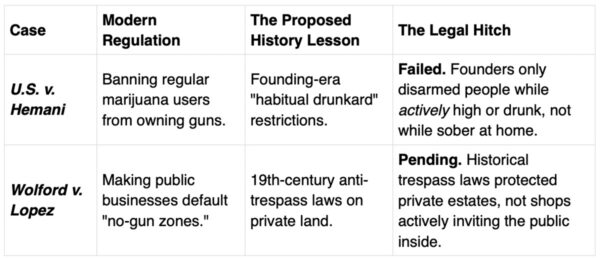
The Drug User Gun Ban (United States v. Hemani)
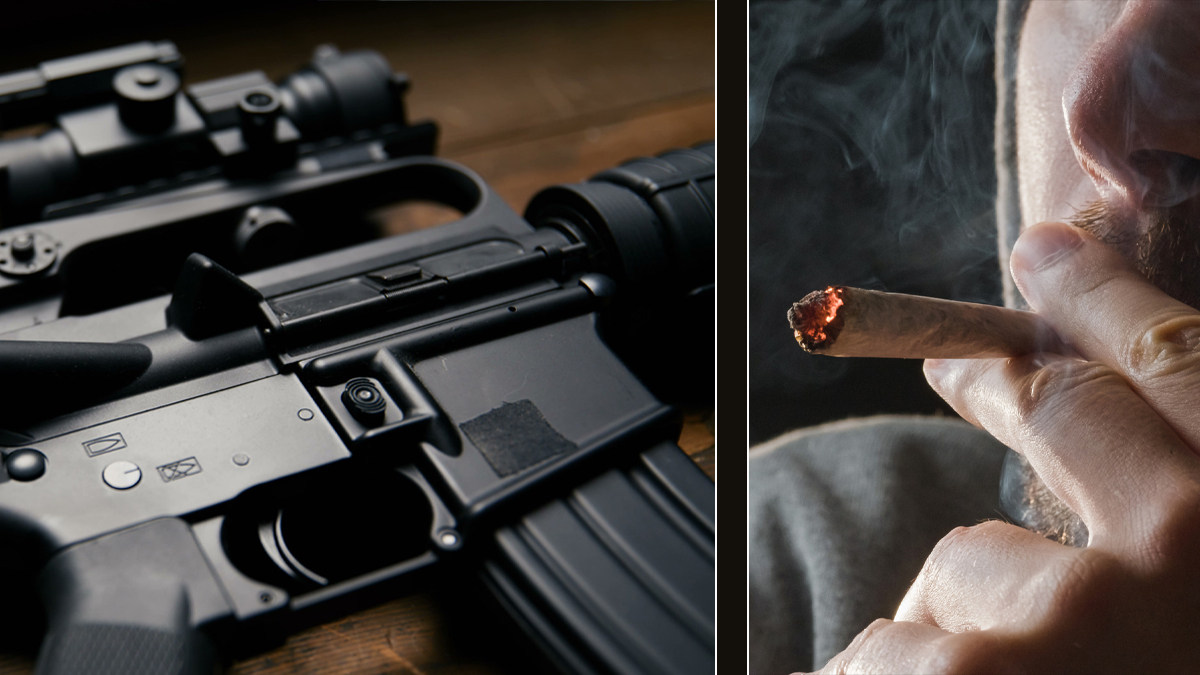
In a striking 9-0 unanimous ruling, the Supreme Court completely upended how federal gun laws apply to regular drug users, using cannabis as the primary example.
The Real-World Scenario
Imagine a person living in a state where recreational marijuana is legal. On a Friday night, they sit at home watching TV, completely sober. Upstairs in their nightstand, they keep a licensed handgun for self-defense and a small amount of marijuana.
Under the old rules: Because federal law bans any “unlawful user” of a controlled substance from possessing a firearm, this person was automatically committing a serious federal felony, even while sitting completely sober in their own living room.
How the History Test Blew It Up
The federal government tried to save the law by pointing to 18th-century “habitual drunkard” laws, arguing that the Founders restricted heavy drinkers from having guns. But the Supreme Court unanimously dismantled that comparison:
Active Impairment vs. Flat Bans: The Founders only regulated guns when someone was actively dangerous or publicly intoxicated (e.g., “You cannot fire a gun in town while drunk”).
The Verdict: The Court found absolutely no historical tradition of stripping sober citizens of their constitutional rights just because they occasionally or regularly use an intoxicating substance. Because the historical analogy failed, the modern blanket ban was ruled unconstitutional as applied to Hemani.
Hawaii’s “Vampire Rule” (Wolford v. Lopez)
With Hemani decided, the Court is turning this exact same history test toward Hawaii’s controversial “sensitive places” law, which treats public-facing businesses as default “no-gun zones.”
The Real-World Scenario
You are a law-abiding citizen with a valid concealed carry permit running errands. You pull into a gas station, walk into a pharmacy to pick up a prescription, and grab dinner at a local diner.
Under Hawaii’s Law: The moment you step onto the property of the gas station, pharmacy, or diner, you are automatically committing a crime unless that business has put up a sign explicitly saying, “Guns Allowed.” If there is no sign, it is a default criminal “No.”
How the History Test Applies Here
Hawaii is defending its law by pointing to 19th-century anti-trespass laws that banned people from carrying guns onto private plantations or farms without permission.
Commercial vs. Domestic Space: Gun rights advocates point out that the historical test requires looking at the intent of the old laws. 1800s trespass laws were meant to protect enclosed, private, domestic lands from intruders, not commercial businesses that throw their doors wide open to invite the general public in to spend money.
The Expected Verdict: If the court applies the history test as strictly as they did in Hemani, Hawaii’s rule will likely fail. While a private business owner always retains the right to put up a “No Guns” sign, the government cannot create a sweeping, default-closed setting for every public-facing business on the map.
Summary Comparison
250 Years of Freedom: A Patriotic Defense of the Second Amendment
This strict focus on “History and Tradition” isn’t just a dry academic exercise for lawyers; it is a vital shield safeguarding the fundamental liberties of every American. As our nation marks its historic 250th anniversary this year, we are reminded that the United States was born from a fierce, unyielding devotion to individual freedom.
When the Founders drafted the Declaration of Independence in 1776, they declared that our rights come from our Creator, not from the grace of a government. And when they ratified the Bill of Rights, they placed the Second Amendment right alongside freedom of speech and religion for a profound reason: the right of law-abiding citizens to keep and bear arms is the ultimate guarantor of a free state.
As the Supreme Court holds the line against government overreach, these rulings ensure that the core tenets of American liberty survive intact. A quarter-millennium after our founding, the truth remains simpler than ever: a nation cannot remain truly free if its citizens are systematically disarmed. Embracing our heritage means protecting the absolute right of the people to defend their lives, their families, and their communities.
Supreme Court Rules Federal Drug-User Gun Ban Falls in US v. Hemani
Maryland Court Finds Gun Possession Alone Not Enough For Police Stop
About Sean Maloney
Sean Maloney is a criminal defense attorney, co-founder of Second Call Defense, and an NRA-certified firearms instructor. He is a nationally recognized speaker on critical topics, including the Second Amendment, self-defense, the use of lethal force, and concealed carry. Sean has worked on numerous use-of-force and self-defense cases and has personally trained hundreds of civilians to respond safely and legally to life-threatening situations. He is a passionate advocate for restoring the cultural legitimacy of the Second Amendment and promoting personal responsibility in self-defense.