A Texas federal court has vacated ATF’s controversial “Engaged in the Business” rule, ruling that the agency exceeded the authority Congress actually gave it under the Bipartisan Safer Communities Act.
Rep. Bonnie Watson Coleman’s HEAR Act is being sold as “gun safety,” but the bill text tells a different story. It would ban possession of suppressors, offer no broad grandfather clause for ordinary citizens, and create a federal buyback program for millions of lawfully registered owners.
ATF has proposed removing several former Soviet countries from its automatic firearm and ammunition import denial list, a small but welcome move away from outdated federal restrictions that have limited choices for American gun owners.
ATF’s new reform package has the gun-control lobby in full panic mode. Everytown claims the changes are a gift to the gun industry, but many of the proposals simply roll back Biden-era overreach and restore common sense for lawful gun owners.
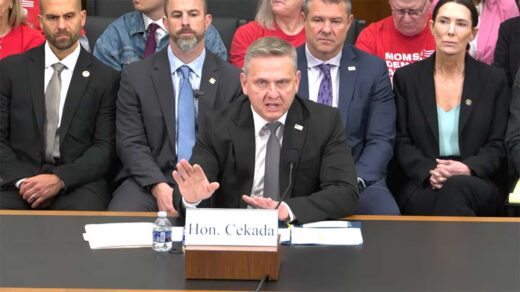
ATF Director Robert Cekada told Shermichael Singleton that the Bureau needs to focus on criminals, not ordinary gun owners, while Chief Counsel Robert Leider defended rolling back rules that stretched beyond Congress’s intent.
ATF Director Robert Cekada told senators the Bureau’s $1.65 billion FY2027 budget request would support violent-crime enforcement, firearms-trafficking investigations, NIBIN, eTrace, and partnerships with state and local law enforcement.
ATF Director Robert Cekada faced House Oversight questioning over the agency’s handling of protected gun trace data, the Tiahrt Amendment, and growing concerns that ATF’s massive digitized records system edges too close to the national gun registry Congress banned.
ATF’s draft revised Form 4473 would cut the firearms transaction form from seven pages to four while changing several key buyer questions. The proposal affects sex identification, marijuana language, straw purchase warnings, firearm type entries, and possible non-over-the-counter transfers.
ATF’s proposed rule would expand non-over-the-counter firearm transfers, allowing same-state FFLs to verify buyers remotely and ship firearms directly after federal checks are complete.
ATF’s new rule removes the bump-stock language invalidated by the Supreme Court in Garland v. Cargill, but it does not fully restore every affected regulation to its pre-2018 form. Gun owners should pay close attention to what ATF left behind.
The Second Amendment Foundation is asking the U.S. Supreme Court to review Patrick Tate Adamiak’s NFA case, warning that lower courts are narrowing Bruen before the government ever has to defend its firearms laws with historical evidence.
Congress reduced the NFA tax on suppressors to $0, but suppressors remain trapped inside the federal registration system. Now several states are moving to clean up their own laws before gun owners get caught in another legal mess created by decades of federal overreach.
Arkansas state senators are demanding a DOJ investigation into the 2024 ATF raid that killed Bryan Malinowski, raising questions about tactics, body cameras, notice, and the agency’s “engaged in the business” enforcement.
DOJ and ATF rolled out a historic 34-rule reform package aimed at reducing burdens on gun owners and the firearms industry. AmmoLand was there for the signing, but major questions remain over the frames-and-receiver rule, ATF’s out-of-business records database, and accountability after the Bryan Malinowski raid.
ATF’s new reform package targets pistol braces, bump stocks, FFL paperwork, NFA travel rules, CLEO notices, and other regulatory burdens on gun owners and firearm businesses. It is real progress, but gun owners should read the fine print.
Gun owners do not want Biden’s ATF rulebook cleaned up and handed to the next anti-gun administration. They want the frames-and-receivers rule repealed, the pistol brace trap buried, the “engaged in the business” rule rescinded, zero tolerance permanently ended, and ATF’s backdoor gun registry destroyed.
Attorneys representing the plaintiffs in a federal lawsuit challenging the constitutionality of the National Firearms Act (NFA) have filed a motion for summary judgment in U.S. District Court for the Eastern District of Kentucky.
Critics say Trump has not done enough for gun owners because the ATF still exists and the NFA and GCA remain law. But presidents cannot repeal statutes by executive order. The better question is what Trump has done with the authority he actually has.
A federal judge in Alabama has paused Butler v. Bondi, the NRA-backed challenge to ATF’s 2024 “engaged in the business” rule, until the Senate votes on ATF Director nominee Robert Cekada.
DOJ and ATF have reversed course once again, now telling courts that a new frames and receivers rule is on the way. The move keeps the legal fight alive in VanDerStok and Defense Distributed while raising fresh concerns for hobbyists, manufacturers, and gun rights advocates.
In a new filing in VanDerStok v. Bondi, the ATF asked a federal court in Texas to stay the case for 90 days while it prepares a revised Frames and Receivers Rule.
The U.S. Court of Appeals for the Eighth Circuit overturned a machine gun possession conviction against an Iowa police chief in United States v. Brad Wendt, while leaving fraud convictions intact.
The Bureau of Alcohol, Tobacco, Firearms and Explosives (ATF) has quietly built what amounts to a backdoor gun registry — in violation of federal law.
Approvals don’t erase the infringement. They reveal the needless bureaucracy of fingerprints, photos, forms, and months-long waits.
By all accounts, Cekada passed the test, and he will likely become the next Director of the Bureau of Alcohol, Tobacco, Firearms and Explosives.
A key theme emerged around Second Amendment protections. Cekada repeatedly vowed that the ATF’s mission is “not to burden lawful gun owners.”
The Trump-ATF issued an interim rule that quietly but significantly narrows how the federal government defines who is prohibited from owning or purchasing a firearm due to drug use.
With Trump reversing Biden’s rules and installing leadership that understands both law enforcement and constitutional rights, the pro-gun community sees a rare opportunity for real reform.
The Biden administration’s ATF made submitting a Form 1 to make a silencer/suppressor much more difficult. Will the Trump administration remove those barriers?
Any time you have evidence of private entities coordinating with federal agents to strip Americans of their rights, the public should be alarmed and demanding answers and action…

 RSS feed