The Supreme Court’s 9-0 Hemani judgment rejected automatic disarmament based solely on regular marijuana use. Its rigorous historical analysis could also spell trouble for Hawaii’s “Vampire Rule” in Wolford v. Lopez.
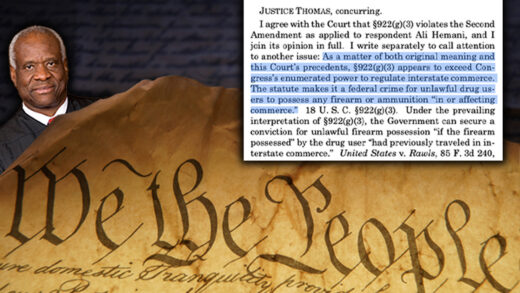
Justice Clarence Thomas says the federal government’s constitutional problem may extend far beyond marijuana users. His Hemani concurrence invites courts to reconsider whether Congress has the authority to criminalize purely intrastate gun possession under §922(g).
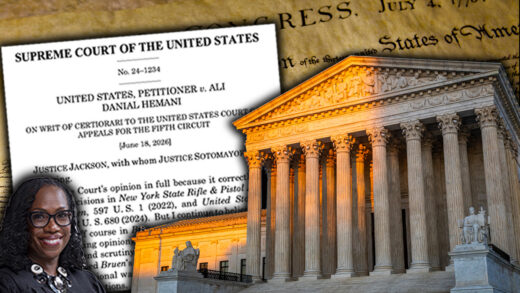
Justice Ketanji Brown Jackson joined the unanimous judgment protecting Ali Hemani’s Second Amendment rights. Her concurrence, however, called Bruen a “failed experiment” and urged a return to government-friendly means-end scrutiny.
Virginia is defending its new gun restrictions by portraying AR-15s as “weapons of war.” From colonial muskets to surplus M1 Carbines, American history tells a very different story.
Forest Pines Condominiums has banned residents from carrying firearms on sidewalks, in parking areas and throughout other shared spaces. But South Carolina law and a prior attorney general opinion leave major questions about the HOA’s authority.
In a unanimous 9-0 ruling, the Supreme Court rejected the federal government’s attempt to disarm a regular marijuana user under 18 U.S.C. § 922(g)(3), strengthening Bruen and requiring individualized evidence before Second Amendment rights are stripped away.
A Spotsylvania Circuit Court judge denied a preliminary injunction in Curtis v. Katz, allowing Virginia’s semiautomatic firearm and magazine ban to proceed while gun owners continue their constitutional challenge.
The Fifth Circuit ruled that suppressors are protected “Arms” under the Second Amendment, creating a direct split with the Ninth Circuit while leaving the NFA registration fight for another day.
A Rolling Stone profile of 3D gun maker YZY_PRINTS shows how far DIY firearms have come. What started as an underground experiment is now a growing movement built on self-reliance, open-source design, and resistance to gun control.
The Supreme Court’s decision in United States v. Hemani rejects automatic status-based disarmament under § 922(g)(3), telling the federal government that marijuana use alone does not erase the Second Amendment.
A new AP-NORC poll shows a sharp partisan divide over whether the right to keep and bear arms is under threat, with Democrats far less concerned than Republicans and independents.
Florida Attorney General James Uthmeier says the state will not appeal after the Fourth DCA ruled Florida’s concealed-carry ban for adults under 21 unconstitutional.
The Supreme Court is expected to release decisions soon in Wolford v. Lopez and United States v. Hemani, two Second Amendment cases that could clarify how lower courts apply Bruen after Rahimi.
James Harden’s Texas gun arrest in Houston over the weekend raises a bigger question: Why arrest someone over how he travels with a legally owned firearm?
GOA, GOF, VCDL, and John Crump have asked the Supreme Court of Virginia to step in before Virginia’s July 1 “assault firearms” and magazine ban takes effect.
Virginia’s new “assault firearms” law is already creating confusion before enforcement begins, with the Senate and House sponsors offering conflicting explanations about what conduct is actually illegal.
The Appellate Court of Maryland ruled that police cannot stop and search a licensed gun owner based solely on the sight of a firearm, marking another important post-Bruen win for armed citizens’ constitutional rights.
The Supreme Court declined to hear NSSF v. James, leaving New York’s gun-industry public nuisance law standing for now.
Two major Second Amendment cases are sitting before the Third Circuit, and the court’s silence may be strategic.
A deadly Kyiv supermarket attack has pushed Ukraine’s civilian firearms debate back into the spotlight, with Interior Minister Ihor Klymenko and President Volodymyr Zelensky signaling support for a modern law on civilian gun ownership and armed self-defense.
A Texas federal court has vacated ATF’s controversial “Engaged in the Business” rule, ruling that the agency exceeded the authority Congress actually gave it under the Bipartisan Safer Communities Act.
Simply put, as noted in the Statement of Facts, “The weapons banned by the act are the arms of the citizen militia.”
The Supreme Court denied review in United States v. Cockerham, leaving in place a narrow Fifth Circuit ruling that rejected a lifetime federal gun ban as applied to a man convicted of failing to pay child support.
The NRA Foundation, now calling itself the 1791 Foundation, controls a donor-funded treasury worth more than $200 million. The question now is whether governance reforms meant to protect the charity have instead handed control to many figures tied to the old NRA power structure.
Rep. Bonnie Watson Coleman’s HEAR Act is being sold as “gun safety,” but the bill text tells a different story. It would ban possession of suppressors, offer no broad grandfather clause for ordinary citizens, and create a federal buyback program for millions of lawfully registered owners.
The Delaware Supreme Court heard arguments in Birney, a major challenge to HB 451, which restricts firearm ownership and possession by adults ages 18 to 20.
A California father ran toward danger after hearing screams and gunfire coming from his San Jacinto home. Authorities say he confronted a shotgun-armed intruder, returned fire, and survived.
Missouri SB 905 would create a new class of trained school protection officers known as Missouri Rangers, giving school districts another option to defend students, teachers, and staff.
A Lancaster County judge stayed proceedings in Crump v. Katz, delaying a June 12 emergency hearing while a three-judge panel considers whether several Virginia SB749 lawsuits should be consolidated or transferred.
A new American Suppressor Association market analysis shows suppressor demand exploding after the federal $200 transfer tax dropped to $0. Gun owners submitted 660,744 suppressor Form 4 applications in the first four months of 2026, raising a major question: if the NFA tax is gone, why does the registry remain?

 RSS feed